Connections Connect The Words
InQuisiTiVe MediaWord
4.586.00 Reviews
- Version
- 1.0.74
- Installs
- 10.00K
- Age Rating
- Everyone
Screenshots
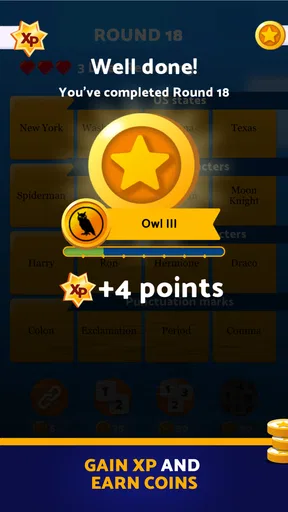
Our Review of Connections Connect The Words
 Analysis by Appyee
Connections Connect The Words is a free word game from InQuisiTiVe Media that focuses on a simple but surprisingly demanding task: finding relationships between words and grouping them in the right way. I like this kind of puzzle because it looks approachable at first, yet a familiar word can easily pull me toward the wrong answer. The challenge comes less from knowing obscure vocabulary and more from spotting the intended connection while resisting tempting alternatives.
After spending time with it, I see the game as a good fit for short mental breaks, quiet evenings, and anyone who enjoys word puzzles that reward flexible thinking. It is listed for Everyone, so its basic concept is suitable for a broad audience, although younger players may still find some groupings difficult depending on their vocabulary and reasoning experience. The game is free to start, with optional in-app purchases ranging from $2.99 to $18.99 per item.
Why the connection-based format is the real appeal
The central capability here is not simply arranging letters or guessing a definition. It is recognizing that several words belong together for a particular reason. That distinction gives the game its personality. A word may fit more than one possible group in my mind, and the puzzle only becomes clear when I compare it with every other option on the board.
The important skill is switching viewpoints before committing. I might first notice a group based on meaning, then realize another group is built around a shared phrase, a category, or a different relationship. That uncertainty creates the tension. The game asks me to keep several interpretations active instead of grabbing the first pattern that seems plausible.
This makes Connections Connect The Words different from a conventional crossword or a standard word-search game. A crossword normally gives me a clue and a fixed number of spaces. A word search rewards visual scanning. Here, the work happens in the space between words: I need to decide why they belong together and whether that reason is strong enough to separate them from the remaining choices.
The format also makes the game feel more conversational than many solitary word titles. When I get stuck, I naturally start explaining possible groups to myself: “These look related because of this, but does the fourth word really fit?” That small act of verbalizing the relationship is useful. It turns a vague hunch into something I can test rather than something I accept immediately.
How I approach a difficult board
My most reliable method is to avoid solving the whole puzzle in one leap. I begin by scanning for the most obvious relationship, but I do not treat an obvious pair as proof of a complete group. Two words can share a theme while still belonging to different intended answers. I look for the remaining members that make the connection precise.
Once I see a possible group, I mentally remove those words and inspect what remains. This is where the game’s design becomes more interesting. A word that seemed ambiguous at the beginning may become much easier to place after stronger candidates have been separated. In practice, solving one group often reveals another rather than simply reducing the board by a fixed amount.
I also recommend testing the weakest word in a proposed group. The strongest three matches can be misleading if the fourth is only loosely connected. Asking myself whether that last word fits in exactly the same way prevents many careless choices. This is a small habit, but it changes the game from guessing to comparing evidence.
When I am torn between two interpretations, I prefer the one that explains all the words with fewer exceptions. That does not mean the answer is always the most familiar category. It means the relationship should feel consistent. This is one of the more useful lessons the game offers: a clever partial pattern is less valuable than a complete, clean one.
A realistic everyday use
The best setting for me is a short break when I want something more engaging than scrolling but less demanding than a long game session. I can open a puzzle while waiting for an appointment, during a commute when I am seated, or after dinner when I want to exercise my attention without starting a large project. The word-based format makes it easy to return to the same mental task after an interruption.
It also works well as a shared puzzle. I can show a board to a friend or family member and compare the groups we notice first. One person may spot a phrase-based relationship while another sees a category built around objects, actions, or names. That difference is part of the fun, because the discussion exposes how many ways the same word can be interpreted.
For a family setting, I would treat it as a cooperative conversation rather than a test of who has the largest vocabulary. If a child does not know one word, the group can explain it and then focus on the relationship. The Everyone age rating makes the game broadly accessible, but the actual experience will still depend on reading ability and familiarity with the vocabulary used in a puzzle.
For language learners, I see a useful but limited role. The game can encourage attention to categories and word associations, yet it may be frustrating if too many terms are unfamiliar. I would use it alongside a dictionary or language-learning routine, not as a replacement for structured lessons. Its value for learners is strongest when the player already understands most of the words and is practicing nuance rather than decoding every entry.
Where it differs from familiar word games
Compared with crosswords, this game gives me less help from a clue structure and more freedom at the beginning. That freedom is exciting when I notice a strong pattern, but it can also feel less forgiving when several words appear to fit. Someone who enjoys precise clues and gradual letter placement may prefer a crossword because each answer is constrained by intersecting entries.
Compared with anagrams, the emphasis is different again. An anagram game usually rewards speed, spelling, and the ability to rearrange letters. Connections Connect The Words rewards classification and interpretation. I do not need to manipulate a word physically to solve the puzzle; I need to understand how it relates to its neighbors.
Compared with a word search, it is less relaxing for me. Word searches can become almost meditative once I settle into a visual rhythm. This title keeps asking me to make judgments, and a board that looks nearly solved can still contain a trap. I would choose this game when I want active reasoning, not when I am looking for a purely calming activity.
That comparison also explains who may want to skip it. If you dislike ambiguity, feel annoyed when a word seems to support several categories, or mainly want a fast score-based challenge, the connection format may feel unnecessarily argumentative. A spelling game or timed anagram title would probably offer a cleaner sense of progress.
The tradeoff between accessibility and depth
The basic idea is easy to understand, which is one of the game’s strengths. I do not need a long tutorial to know what kind of thinking is expected. However, simple rules do not guarantee simple puzzles. The difficulty comes from the quality of the relationships, and that means my enjoyment depends heavily on whether a board feels fair rather than merely obscure.
When a puzzle is well balanced, I can see why my first guess was tempting and why the final arrangement is stronger. That is satisfying. When a connection feels too broad or relies on a meaning I would not normally use, the experience becomes less rewarding. The difference is important: being challenged is enjoyable, while feeling that the answer depends on an unexpected interpretation can feel arbitrary.
I also find that the game favors patience over rushing. A quick guess may work on an easy board, but on a close one it can make the remaining words harder to read. My practical advice is to pause before selecting a group that contains a word with an obvious alternative. Rechecking the board costs little and often exposes the intended structure.
The free entry point is convenient for trying the game without making a commitment. At the same time, optional purchases mean players should pay attention before buying anything. I would recommend starting with the free experience and deciding whether the puzzle style genuinely fits your habits before considering an optional item. That is especially sensible for families sharing a device.
Small habits that improve the experience
One useful technique is to separate certainty from possibility. I mentally mark a word as “nearly certain,” “plausible,” or “unexplained.” I only commit when a group has enough strong members and the weaker member does not create a contradiction. This prevents one attractive association from controlling the entire board.
Another technique is to search for unusual wording rather than the most common meaning. If a word appears too ordinary, I ask whether it might be functioning as part of a phrase or as a label in a broader category. This does not require inventing wild interpretations; it simply keeps me from treating the first definition that comes to mind as the only one.
I also recommend solving away from the screen for a moment. In a difficult puzzle, I may read the remaining words aloud or write down a few candidate groups. That changes the problem from visual clutter into a set of explicit comparisons. It is particularly helpful when two possible groups overlap and I need to see which arrangement leaves a coherent remainder.
A final tip is to notice the emotional trap of being almost finished. When only a few words remain, I am more likely to assume they must form the obvious group. That is exactly when I slow down. The last decision deserves the same scrutiny as the first, because a near-solution can still rest on a mistaken earlier assumption.
Who gets the most from it
I would recommend this game first to people who enjoy language but do not necessarily want to write long answers. It suits players who like categorizing, spotting patterns, debating meanings, and revising an initial theory. It is also a good choice for someone who wants a compact puzzle that can become a conversation when played with another person.
It is less suitable for players seeking a strong narrative, a large progression system, or action-oriented variety. The appeal is concentrated in the word relationships themselves. If that central activity does not hold your attention, there is not much else to distract from it. I would also point impatient players toward faster word formats if they prefer immediate feedback over careful interpretation.
The game has attracted an average rating of 4.5 from around 411 ratings, with roughly 86 written reviews, and it has passed 10K+ installs. Those figures suggest that it has found an audience, but I would still judge it by the specific kind of thinking you enjoy. Popularity cannot turn an ambiguous puzzle into a satisfying one for somebody who dislikes this format.
InQuisiTiVe Media has kept the concept focused rather than burying it under unrelated mechanics. The current version is 1.0.74, and the game runs on Android 6.0 or later. That makes it accessible to many older devices, although anyone using a much older phone should still expect the experience to depend on the device itself.
My recommendation after playing
Connections Connect The Words works best when I approach it as a reasoning exercise, not as a race. Its strongest feature is the way it makes ordinary words feel unstable: each one can point in several directions until the full pattern becomes visible. That creates satisfying moments of discovery and gives even a short session some mental weight.
I would choose it over a crossword when I want open-ended association, and over an anagram game when I want to think about meaning rather than spelling. I would choose something else when I need a relaxing visual pastime, a story, or a clearly measurable speed challenge. The game’s limitations are tied directly to its main idea, so the right audience matters more than a long feature list.
For me, the best reason to install it is the opportunity to practice careful interpretation in small, manageable sessions. Start with the free version, resist locking in the first attractive group, and treat uncertain words as clues rather than obstacles. If you enjoy that process, Connections Connect The Words offers a focused and replayable word-puzzle experience. If ambiguity feels like a flaw rather than part of the fun, its central strength will probably be the exact reason you move on.
Verdict
Strengths of Connections Connect The Words
- Simple word-linking gameplay is easy to understand from the first puzzle.
- Short levels make it convenient for quick sessions on the go.
- Increasing difficulty provides a steady challenge as you progress.
- Clean visuals keep attention focused on the words and connections.
- Hints can help when a puzzle leaves you temporarily stuck.
Limitations of Connections Connect The Words
- Some puzzles may accept only one expected word connection.
- Later levels can feel repetitive if you play for long sessions.
- Hints may be limited or tied to an in-game currency system.
- Small wording differences can make certain answers feel unclear.
- Offline availability and progress syncing may vary by device.
Similar Picks in This Category
View All
Word Search - Word Puzzle Game
Bluetile4.8

Word Search Quest - Puzzles
Blackout Lab4.8

CodyCross: Crossword Puzzles
Fanatee, Inc.4.7

Words of Wonders: Crossword
Fugo Games4.9

Wordscapes: Word puzzle game
PeopleFun4.7

Word Search Explorer
PlaySimple Games4.9
Frequently Asked Questions
What is Connections Connect The Words?
Connections Connect The Words is a word-association puzzle game in which you sort a collection of words into groups that share a common connection. Each puzzle challenges you to identify four related categories while avoiding misleading combinations. The game is designed for short sessions, but the increasing difficulty can make later rounds surprisingly demanding for players who enjoy vocabulary, logic, and pattern-recognition challenges.
How do you play Connections Connect The Words?
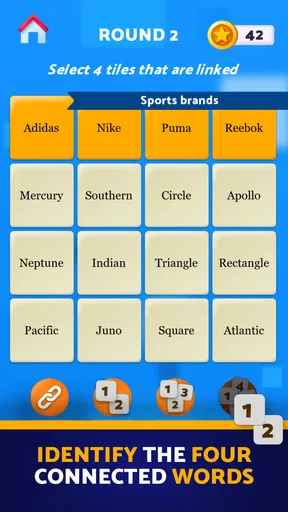
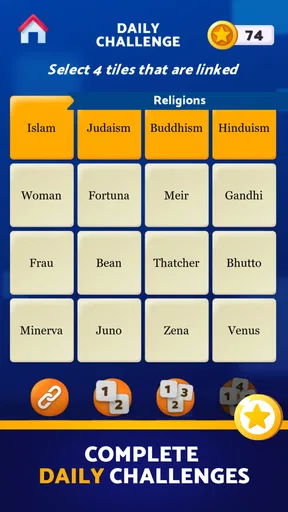
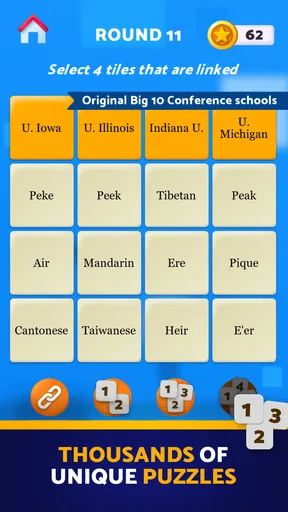
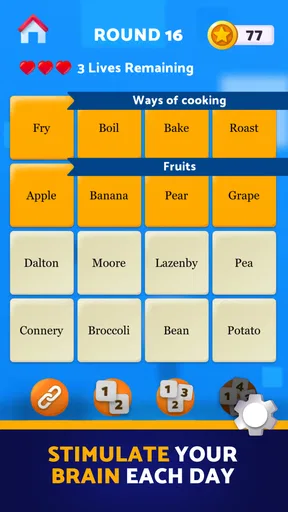
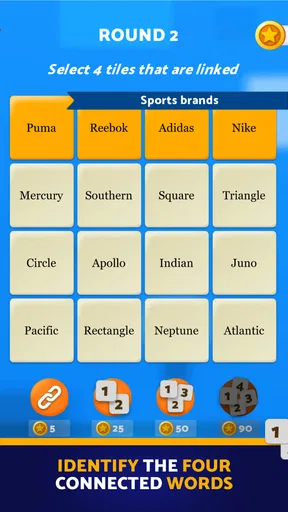
A typical round presents a grid of words, and your goal is to select four words that belong to the same category. After confirming your choice, the game tells you whether the connection is correct. You continue grouping the remaining words until the puzzle is solved or your available mistakes are used. Some words may fit more than one idea, so careful comparison is essential.
Is Connections Connect The Words free to download and play?
The game can generally be downloaded without an upfront purchase, although the exact availability of advertisements, optional purchases, or premium features may depend on the Android or iOS version and your region. Before installing, it is worth checking the store listing for current pricing details, in-app purchase information, and whether any subscription is required for extra content or an ad-free experience.
Does the game require an internet connection?
Many word-puzzle games can be opened and played offline, but some features may depend on an active internet connection. Daily challenges, advertisements, progress synchronization, leaderboards, analytics, and updates may not work without connectivity. If offline play is important to you, check the app’s current store description and test the game after installation, since connection requirements can change between versions.
Who will enjoy Connections Connect The Words?
Connections Connect The Words is best suited to players who like vocabulary games, trivia, brain teasers, and logic puzzles rather than fast action or complex controls. It is accessible for casual players, yet the deliberately ambiguous word choices can challenge experienced puzzle fans. Younger users may also enjoy it, although some categories can involve cultural references or language knowledge that varies by age and region.
Play our best games!


